16 September 2026
HUMAN + MACHINE // PART 01 - The Journey
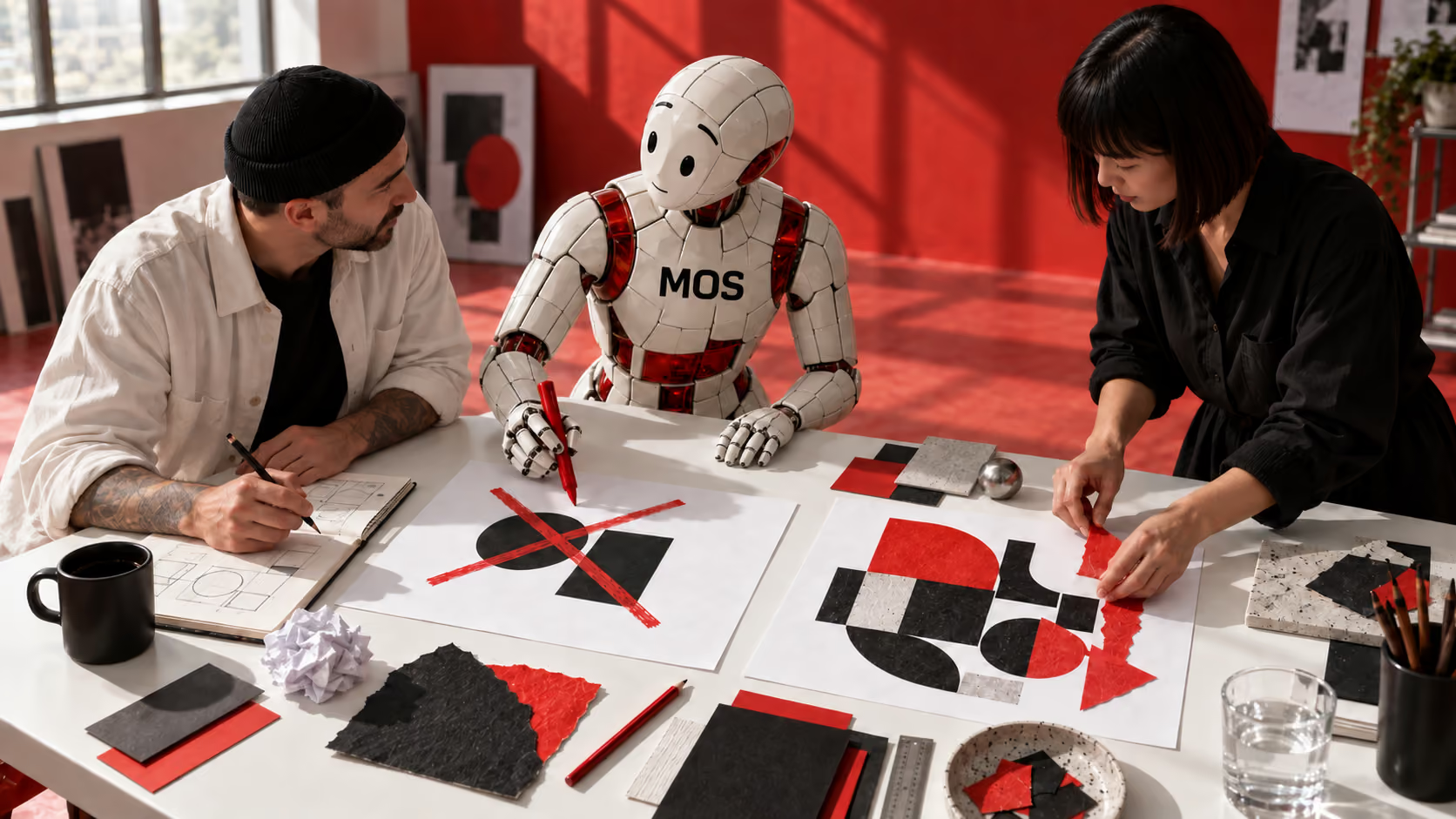
That's the whole problem, right there. It's underneath all the chatter on LinkedIn about AI giving people garbage, prompting taking longer than the actual work, AI killing creativity. Those complaints are mostly fair, because most people are asking a platform with no durable memory and minimal customisation to do their entire job, and the platform's only real instinct is to agree with them.
I was one of those people. I tried to let AI do the job and got angry at it when it referenced a past chat about a lemon chicken recipe in the middle of designing a strategy for a client in the FMCG industry, or when I asked for a competitive analysis on a product I was developing and it made up a competing product entirely. The brand was right. The product was a complete fabrication or as we know it, “hallucination”, delivered without a flicker of doubt.
Over the past three years I've engrained myself in building a system that fights this. Not fully autonomously, but in collaboration with us. I say system deliberately, because AI on its own is just a computer with a large vocabulary and some tools, good for crappy social media copy or an image of a man with delusions of grandeur calling himself a healer, you know the guy. The model only sets the floor, what we actually wanted was the opposite of a people-pleaser: something that finds gaps in our thinking and challenges our approaches, remembers what a client said months ago so we don’t repeat the same mistakes, and executes at speed.
A team member, not a fleet of agents
So I built a version of my team inside a computer and called it MOS. Not a plethora of a agents autonomously doing the work for us. A team member that works with us. Under the hood it runs on four layers, and they're simpler than they sound.
The persona layer
First, there's the persona layer. Whoever is using MOS has their standards, tone and working style locked in. It adapts to the person at the keyboard, not the other way around.
The client brand brain
Second, there's the client brand brain. Every client has their own isolated storage container running on our own local server, not floating around in someone else's cloud waiting to be another headline. It holds that client's values, brand guidelines, past briefs and every piece of work we've ever produced for them, fed only by what clients tell us, tell the public, or send us, nothing is ambiguously obtained. And it never mixes my personal data or Client A's context with Client B's, the biggest win of my journey.
Hard gates
Third, there are hard gates, this is what fixed the hallucination problem. MOS flags every claim and asks us to verify it, and nothing becomes a stored fact about a client until a person on my team has checked and approved it. So when asking it to perform a web search, it finds some random on Reddit with a few bots and some subreddits won’t rewrite how MOS understands our client's business. If we ask it to draft a campaign, it checks our strategic guardrails first, and if the foundations of a brief are missing, it pushes back and stops rather than guessing. That's how we caught an ABAC compliance issue on a custom spirits concept a while back. We gave it the brief, and it flagged that the visual direction I'd asked for would breach advertising rules the client is bound by. A regulatory error caught before we wasted a single hour designing something we could never launch.
Closing the loop
The fourth layer closes the loop. In traditional agency work, the learnings from last year's campaign get buried in a PDF nobody opens again. In MOS, the insight from every finished campaign feeds straight back into the intelligence behind the next one. The brain compounds what it learns and prompts us to verify against historical data.
It suggests. We decide.
There's one more rule sitting above all four layers, and it's the philosophy in a single mechanism: MOS doesn't act on its own. Anything it wants to do in our workspace, file a document, send an email, update a record, arrives as a proposal a human has to approve. It suggests. We decide.
Day to day, that adds up. A new client walks in and MOS has already run an intelligence scout across their public footprint, with reputable cross-checked sources, so we never go into a briefing unprepared. A client asks for last financial year's first-quarter campaign results and instead of thirty minutes of digging and a PDF scraped together from Google Ads and Meta, they get a fully branded report with a link in minutes.
And creative ideation, where everyone says "yeah, I only use it to get ideas": to me that wastes the most powerful technology that has ever existed. What actually happens is people get frustrated with the responses, pull out the good bits, redo the rest themselves, and pay twice for the privilege. Build the rules in, strategic design principles, the industry's and your own, and it stops being a vending machine for average ideas. It starts surfacing the things you forgot, questioning the direction you defaulted to, finding the gaps in your thinking while the thinking is still cheap to change.
No single model does everything
One last thing, because I haven't seen anyone say it. Betting on one model to do everything you ever wanted, then switching subscriptions every time Lord Altman declares we've hit agentic AI or Captain Anthropic releases their smartest model ever, is a recipe for disaster. There is no one size fits all. Different problems need different models, and the people getting real value out of this technology are the ones building systems that route each job to the right one. We benchmark our models against how we work, not against a public leaderboard that has quietly become a paid marketing channel for AI companies.
That's the system. The machine keeps the memory, the humans make the decisions. AI at its best doesn't replace critical thinking, but accelerates it. The loudest voices saying AI is taking their jobs are describing what happens when you settle for average and let the machine agree with you. We don't do mediocre. We built something that won't let us.
Written by Dan Cicivelli, Managing Director and founder of Project Mosaiq.
Helen Keller said character cannot be developed in ease and quiet. Three years of building this with no engineering background tested that theory thoroughly.